
GST for Restaurants in India: Rates, Bills and Filing Basics
Most restaurant owners only need to know four things about GST: which rate applies, who pays on app orders, what goes on the bill, and which returns your CA files. Here they are in plain language.
 Jigar Doriwala · Founder & CEO, FoodChow11 min read
Sample bill (example)
Standalone restaurant, regular GSTIn short: Most restaurants in India charge 5% GST (2.5% CGST + 2.5% SGST) without input tax credit. Restaurants in “specified premises”, meaning hotels whose room tariff crossed ₹7,500 per unit per day in the previous year, pay 18% with ITC. On Swiggy and Zomato orders, the platform pays the GST under section 9(5). Your bill must show your GSTIN and the tax split, and your CA files GSTR-1 and GSTR-3B, or CMP-08 and GSTR-4 on composition.
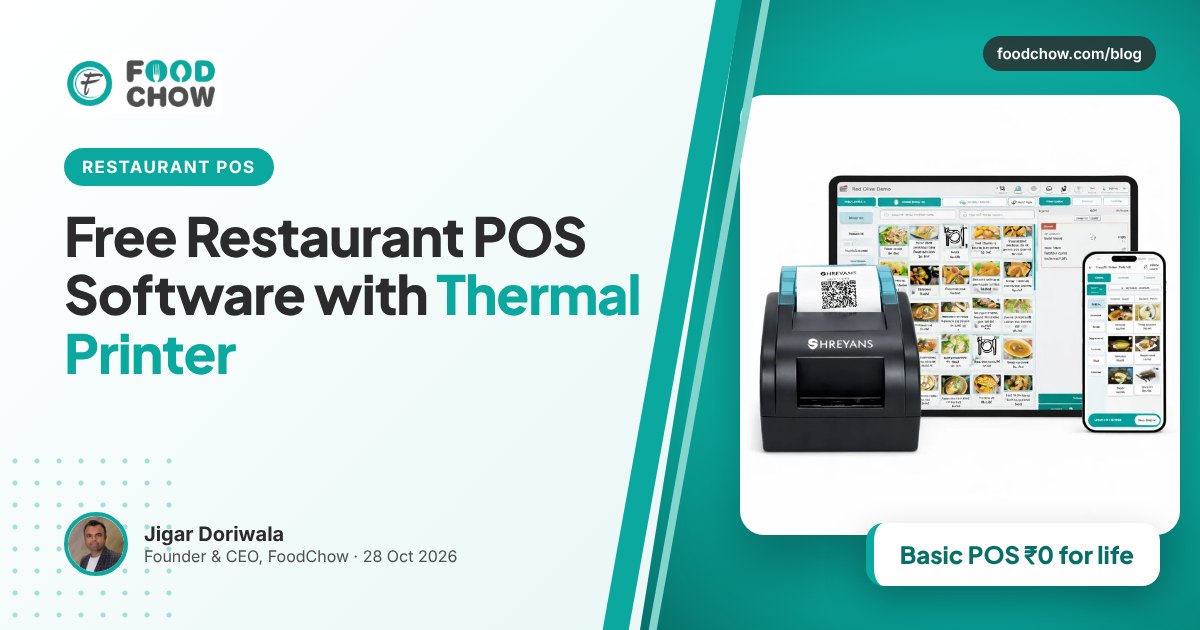
Need GST-ready bills at the counter? Start FoodChow POS free and print bills on your thermal printer.
- 5%standard restaurant rate
- 18%specified premises
- 1 Apr 2025specified premises rule
- 1 Jan 2022apps pay GST, 9(5)
- 996331SAC for restaurant service
 Free for life
GST-ready billing at the counter
- Prints on 58 / 80mm thermal
- Reports from POS Lite
- Bill + KOT printing, free
- 14-day Premium trial
Which GST rate applies to your restaurant?
The rate depends on where you operate, not on what you cook. Here is the rule as it stands, after the April 2025 change and the September 2025 GST Council clarification.
| Your restaurant | GST rate | Input tax credit |
|---|---|---|
| Standalone restaurant, café, QSR, dhaba | 5% (2.5% CGST + 2.5% SGST) | Not available |
| Restaurant in a hotel where room tariff was ₹7,500 or less per unit per day | 5% | Not available |
| Restaurant in “specified premises” (hotel room supply above ₹7,500 per unit per day in the previous financial year) | 18% | Available |
| Composition taxpayer (turnover up to ₹1.5 crore) | 5% of turnover | Not available |
From 1 April 2025, the 18% rate is tied to specified premises (The Week, 27 Mar 2025). In September 2025 the GST Council clarified that a standalone restaurant cannot declare itself a specified premises (EY alert).
Who pays GST on Swiggy and Zomato orders?
Since 1 January 2022, food delivery platforms are treated as the supplier for GST on restaurant services ordered through them, under section 9(5) of the CGST Act (Notification 17/2021-Central Tax (Rate)). They collect and pay the 5% GST on those orders.
So on app orders, you do not charge GST again. On dine-in, takeaway and your own direct online orders, you charge GST as usual if you are registered.

Fees the platform charges you, like commission, are a separate service with their own GST on the platform’s invoice. For the full fee picture, see how to capture direct orders without 30% commission.
Should a small restaurant choose the composition scheme?
Composition is simpler: fewer returns and a flat 5%. But you cannot claim input tax credit, you cannot collect tax from customers (you issue a bill of supply marked as a composition taxable person), and the turnover limit is ₹1.5 crore across all businesses under the same PAN (₹75 lakh in some special category states). Composition also has limits on selling through e-commerce operators, so a kitchen that sells mainly via apps should check with its CA first.
What must a restaurant GST bill show?
- Your name, address and GSTINExactly as on your GST registration.
- A unique bill number and dateSerial numbers, no gaps or repeats in a financial year.
- Description and SACRestaurant service is generally SAC 996331.
- Taxable valueFood value before tax, after any discount.
- CGST and SGST splitFor example 2.5% + 2.5% at the 5% rate.
- Total amountTaxable value plus tax, clearly shown.
On composition, print a bill of supply without tax lines and with the composition legend instead. Set up your bill format once in your POS, print a sample, and show it to your CA before you go live.

Set up your bill format once. Print it right every time.
FoodChow Basic POS is free for life and prints on 58mm or 80mm thermal printers.
Which GST returns does a restaurant file?
| You are | Main returns | How often |
|---|---|---|
| Regular taxpayer | GSTR-1 (sales) and GSTR-3B (summary + payment) | Monthly, or quarterly under QRMP if eligible |
| Regular taxpayer | GSTR-9 annual return | Yearly, if applicable to your turnover |
| Composition taxpayer | CMP-08 (tax payment) | Quarterly, by the 18th of the month after the quarter |
| Composition taxpayer | GSTR-4 (annual return) | Yearly, by 30 April |
Due dates are set by the GST department and can be extended. Check the GST portal or your CA for the current calendar.
Your CA needs clean sales data for these returns: daily totals, tax collected, and app sales shown separately because the platform pays GST on those. On FoodChow, sales reports start with POS Lite, and POS Premium (free for 14 days) adds detailed reports.
What GST mistakes do restaurants make most?
- Charging 18% at a standalone restaurant
The 18% with ITC option is only for specified premises.
- Adding GST on app orders again
The platform pays it under 9(5). Don’t double count.
- Handwritten or gapped bill numbers
Use a POS so numbering is automatic.
- Mixing app and direct sales
Keep them separate for your CA.
- Claiming ITC at 5%
At 5%, input tax credit is not available.
- Composition with app-heavy sales
Check the e-commerce limits with your CA first.
GST for restaurants: FAQs
What is the GST rate for restaurants in India?
Most restaurants charge 5% GST (2.5% CGST and 2.5% SGST) without input tax credit. Restaurants in specified premises, meaning hotels whose room tariff exceeded Rs 7,500 per unit per day in the previous financial year, charge 18% with input tax credit.
Do restaurants charge GST on Swiggy and Zomato orders?
No. Since 1 January 2022, food delivery platforms pay the 5% GST on restaurant services supplied through them under section 9(5) of the CGST Act. Restaurants still charge GST on dine-in, takeaway and their own direct orders.
Can a standalone restaurant charge 18% GST and claim ITC?
No. The GST Council clarified in September 2025 that a standalone restaurant cannot declare itself a specified premises. The 18% with ITC option is linked to hotels whose room tariff crosses Rs 7,500 per unit per day.
What is the composition scheme for restaurants?
Restaurants with turnover up to Rs 1.5 crore (Rs 75 lakh in some special category states) can opt for composition and pay 5% of turnover. They cannot claim ITC or collect tax from customers, must issue a bill of supply, and file CMP-08 quarterly and GSTR-4 yearly.
What is the SAC code for restaurant services?
Restaurant services generally fall under SAC 996331. Confirm the code and wording on your invoice with your CA.

Bill right, every time.
Print clean bills on FoodChow POS, free for life on Basic. Move to POS Lite when your CA wants sales reports; Premium adds detailed reports.
Jigar has spent 14+ years in SaaS and digital strategy and has bootstrapped FoodChow for 8+ years. He helps restaurant owners set up billing, POS and commission-free ordering. Instagram
Are you a CA or consultant who sets up billing for restaurants? See the FoodChow partner program.